

When it comes to budget-friendly hatchbacks in India, two names always dominate the conversation: Maruti Suzuki Alto K10 and Renault Kwid. Today, we dive deep into the Renault Kwid 2025 Review, exploring whether this entry-level car is the perfect rival to the Alto K10 and whether it truly delivers value for money at its price point.
Exterior Design & Styling
Bold and Youthful Design
The Renault Kwid has always been known for its SUV-inspired design language, and the 2025 model continues that legacy. In the blue color variant, the car looks particularly striking and fresh.
The front fascia comes with Renault’s signature grille in a matte finish.
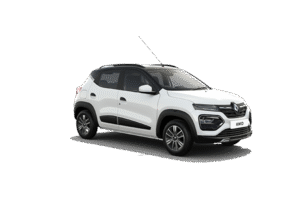
The headlamps are bulb-type with integrated DRLs and indicators. While LED options would have been better, the setup looks clean and modern.
The side profile showcases 14-inch wheels, bigger than the Alto K10’s 13-inch, offering improved road grip (165/70 profile).
ORVMs now feature in-built turn indicators, adding a premium touch.
The rear design remains similar to older models with bulb-type tail lamps, reverse camera, parking sensors, and the classic Renault badging.
Though the design is familiar, it still feels fresh for the segment. Hopefully, Renault may introduce its latest international facelift in India soon.
Interior & Comfort
Entry-Level Yet Practical Stepping inside the Kwid, you’re greeted with a minimal yet functional cabin layout.
Door Panels: Simple plastic finish with bottle holders and utility space.
Steering Wheel:
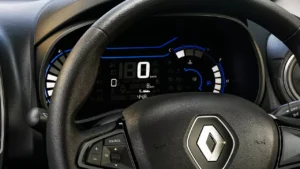
Non-adjustable, but ergonomically designed.
Instrument Cluster: Digital speedometer, gear position indicator, trip meter, RPM gauge, and fuel/temp dials – quite modern for its price range.
Infotainment System: A 7-inch touchscreen unit with radio, media support, and USB connectivity. Sound quality is average, good enough for solo rides.
Air Conditioning: Manual controls with rotary knobs – simple and easy to use.
Charging Ports: USB and 12V socket available for front passengers.
Seating & Comfort
Front Seats:
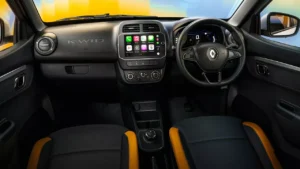
Fabric upholstery with decent cushioning, fixed headrests, and good side bolstering for support.
Rear Seats:
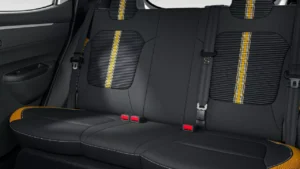
Flat bench with limited back support, no headrests, and no armrest. Space is decent for average-height passengers, thanks to a longer wheelbase than Alto K10.
Overall, the Kwid prioritizes space and practicality over luxury.
Boot Space & Utility

One of the highlights of the Renault Kwid 2025 is its 279L boot space – significantly larger than most rivals in its class.
Enough for one large suitcase and a couple of duffle bags.
Spare wheel provided under the boot floor.
Parcel tray included for added utility.
This makes it a perfect car for small families who occasionally go on weekend trips.
Engine, Performance & Mileage
Engine Specifications
1.0L, 3-cylinder petrol engine (999cc)
Power Output: 67 BHP
Torque: 91 Nm
Transmission Options: 5-speed Manual (MT) & AMT Automatic
Ride Quality
Front Suspension: MacPherson strut for better ride comfort.
Handling: Decent for city rides; feels stable at moderate speeds.
Ground Clearance: Higher than Alto, useful for Indian roads.
Mileage
ARAI Claimed: 22 km/l
City Mileage: ~16 km/l (practical usage)
Fuel Tank Capacity: 28 liters
While the fuel tank is slightly small, the mileage ensures lower running costs.
Price & Variants
The Renault Kwid 2025 is attractively priced, making it an excellent first car for new buyers.
Kwid 1.0 MT (Manual) – ₹5.55 lakh (Ex-showroom) | ~₹6.25 lakh (On-road)
Kwid 1.0 AMT (Automatic) – ₹6 lakh (Ex-showroom) | ~₹7 lakh (On-road)
Competitor Comparison
Alto K10: Slightly cheaper but smaller in size.
Wagon R: Available in similar price range (~₹7 lakh) with more space.
Thus, Kwid positions itself as a value-for-money hatchback between Alto K10 and Wagon R.
Pros and Cons
Pros
Attractive SUV-inspired design
Bigger 14-inch wheels with better road grip
Spacious cabin and large 279L boot
7-inch touchscreen infotainment (rare in entry-level cars)
AMT automatic option at affordable price
Good ground clearance for Indian roads
Cons
No LED headlamps or tail lamps
Small fuel tank (28L)
Rear seat lacks headrests and support
Power window switches placed in center (not on doors)
Basic sound system
Why Choose Renault Kwid 2025?
If you’re looking for an affordable, stylish, and feature-rich entry-level hatchback, the Renault Kwid 2025 is a fantastic option. It combines good looks, modern features, decent performance, and practical space – all at a competitive price.
Whether you’re a first-time car buyer or need a budget-friendly family car, the Kwid delivers strong value for money.
Conclusion
The Renault Kwid 2025 Review makes it clear – this is not just another entry-level hatchback. It’s a serious rival to the Alto K10 and even challenges bigger cars like Wagon R in terms of space and features.
At an on-road price starting around ₹6.25 lakh, the Kwid offers style, comfort, mileage, and practicality – a rare combination in this segment.
So, if you want a budget-friendly yet feature-packed first car, the Renault Kwid 2025 should definitely be on your shortlist.
Renault Kwid 2025 – FAQ Section
Q1. What is the price of Renault Kwid 2025?
The Renault Kwid 2025 starts at ₹5.55 lakh (Ex-showroom) for the manual variant and goes up to ₹6 lakh (Ex-showroom) for the AMT automatic.
Q2. What is the mileage of Renault Kwid 2025?
Renault claims 22 km/l (ARAI-certified). In real-world city driving, expect around 16 km/l.
Q3. How much boot space does the Kwid 2025 offer?
The Kwid offers 279 liters of boot space, one of the largest in its segment.
Q4. Is the Renault Kwid 2025 better than Alto K10?
Yes. The Kwid offers bigger wheels, more boot space, better infotainment (7-inch touchscreen), and SUV-inspired styling compared to the Alto K10.
Q5. Does Renault Kwid 2025 come in automatic?
Yes. The Kwid is available with a 5-speed AMT automatic transmission apart from the manual.
Q6. What are the engine specs of Renault Kwid 2025?
It gets a 1.0L 3-cylinder petrol engine producing 67 BHP and 91 Nm torque.
Q7. What are the main drawbacks of the Kwid 2025?
Small fuel tank (28L), no LED lights, rear seat lacks headrests, and power window switches are placed centrally